ServicesPool Repair
Pool Repair in Sun Lakes
If your pump is running but the returns barely push water, the heater refuses to fire, or there's a puddle under the equipment, we track down the cause and repair it with our own crew. You'll get a clear explanation, a written estimate, and dated photos if an insurance claim is on your mind.
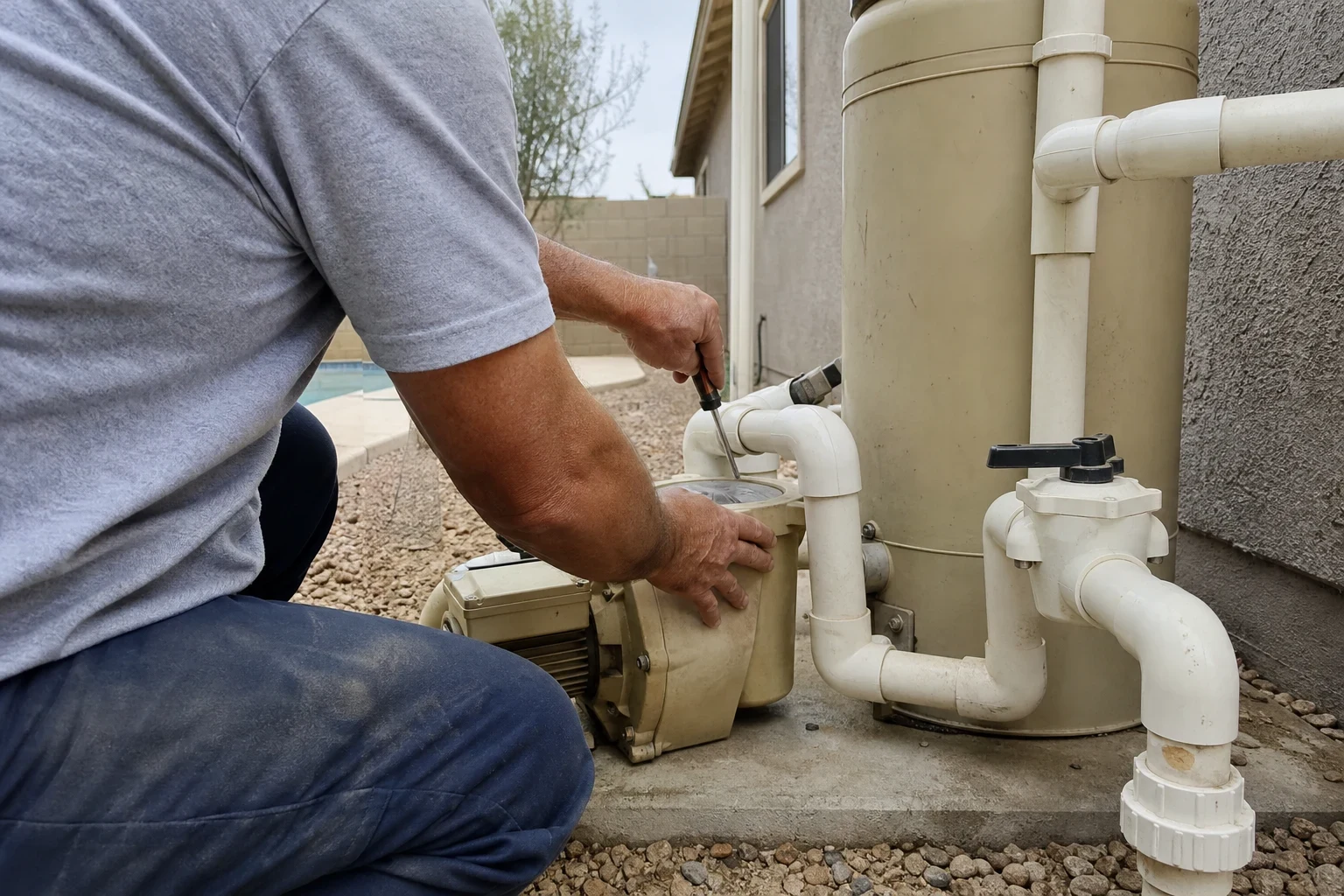
Fixing what stopped working, and explaining why
Most pool trouble begins at the equipment pad. Think of a motor with worn bearings, a split pump lid, a valve that sticks, a heater that keeps faulting, or PVC that the sun has turned brittle. We test each piece, point out what failed and give you an honest view on whether to repair it or put the money toward a replacement.
Every repair is done by our own technicians in-house, never subcontracted. The technician who figures out the problem is the same one who fixes it, so the details you shared on the phone carry straight through to the work.
When a monsoon storm, a power surge or a fallen branch caused the damage, we take dated photos and write a record of what we saw. We're happy to explain how pool claims tend to unfold, but your policy and your adjuster decide coverage, and we'll be straight with you about that.
What our pool repair covers
- Pump and motor repair
- Worn seals and bearings, damaged impellers, failed capacitors and cracked lids are all parts we replace. If the motor itself is close to worn out, you hear that from us before you pay to fix it.
- Heater and heat pump diagnosis
- We read the error codes and test the igniter, sensors and pressure switch to pinpoint why your unit won't start or keeps cutting out.
- Valves, fittings and above-ground plumbing
- Sun-brittle PVC, dripping unions and diverter valves that won't turn get cut out and replaced, then glued properly and checked under pressure.
- Filter housing and gauge repairs
- We swap out broken gauges, cracked clamp bands and tired O-rings so your filter holds a seal and shows an accurate reading. For routine cleaning, see our Filter Cleaning page.
- Damage documentation
- When a storm or surge is behind the failure, you receive dated photos, a note on each damaged part and a line-item estimate ready to share with your insurer.
Signs your pool needs a repair visit
Loud grinding or screeching from the pump
That noise usually means worn motor bearings. Caught early, it's often a bearing job instead of a whole new motor.
Water pooling under the equipment
A drip at a union, pump lid or valve wastes water and can let the pump suck air.
Weak flow at the returns
Bubbles in the pump basket, low pressure or barely moving return jets point to an air leak, a clog or a failing impeller.
Heater error codes or no flame
Repeated faults usually trace back to one sensor or switch, and guessing at parts gets expensive.
Equipment dead after a storm
Monsoon lightning and power surges can knock out pumps and control boards. Don't reset it over and over. Have it checked and photographed first.
How a repair visit goes
- 1
A phone call about what you're seeing
Tell us the sounds, leaks or error codes. We'll ask a few questions and set a time that works for you.
- 2
Diagnosis at your home
We test the equipment, find the failed part and photograph it. You get a straight answer on repair versus replacement.
- 3
Written estimate before any work
Each part and the labor are listed line by line. Nothing starts until you approve it.
- 4
The repair and a test run
Our technician makes the repair, runs the system, checks pressure and flow, and cleans up the equipment area before leaving.
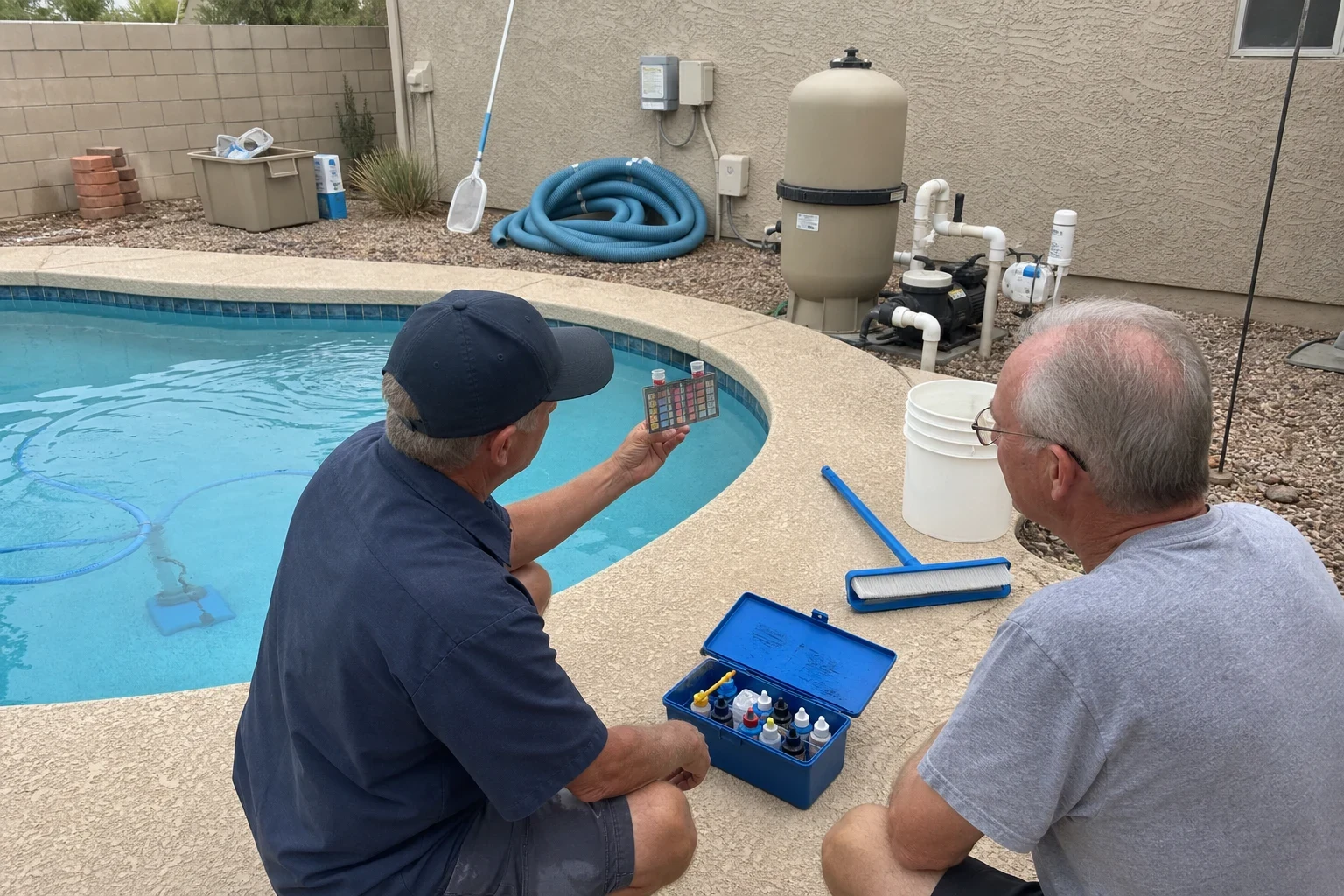
What moves the price of a pool repair
We price a repair only after we've looked at the equipment, because one symptom can trace back to a small part or a major one. The quote is free. Before any work begins, you get a written estimate that breaks out parts and labor separately.
- The part that actually failed
- Swapping a start capacitor or a worn O-ring is a small job. Replacing a motor, a heat exchanger or a control board is a much bigger one.
- Your equipment's age and brand
- Discontinued or older models sometimes need adapter fittings or parts that take longer to track down.
- Room to work at the pad
- Crowded equipment areas, or plumbing that runs into concrete, add labor time just to reach the problem.
- Damage beyond the first part
- When a pump runs dry or a surge travels through the system, more than one component may need attention on the same visit.
Pool repair questions
Something not covered here? (480) 470-8754
Will my homeowners insurance pay for my pool repair?
That comes down to your policy and the cause of the damage. Insurers usually treat sudden events, like lightning, wind or a falling tree, differently from everyday wear, which is generally excluded. We photograph and write up what we find and walk you through the typical steps. The coverage decision belongs to your insurer.
Do you send a subcontractor to do the work?
No. Every repair is handled in-house by our own technicians, never handed off to another company. Whoever finds the problem is the one who fixes it.
Should I repair my old pump or replace it?
When the housing is solid and the motor still has life in it, new bearings or a seal kit is often money well spent. When the motor is tired or the pump is many years old, a replacement may cost you less in the long run. We lay out both choices, and our Equipment Installation page covers what a replacement involves.
Can I keep running the pump while I wait for the repair?
A small drip on a pump that still circulates water is usually fine for a few days. Grinding, overheating or running with no water in the basket are reasons to switch it off right away so the damage doesn't grow. Describe what you're seeing on the phone and we'll tell you which case you're in.
What if my pool turned green while the equipment was down?
Without circulation, algae can take hold within days in warm weather. After the repair, our Green to Clean Recovery service gets the water clear again.
Let's find out what's wrong with your equipment
Describe the noise, leak or error code and we'll book a time to come out, diagnose it and put a written estimate in your hands. If a claim might be involved, photos come first.